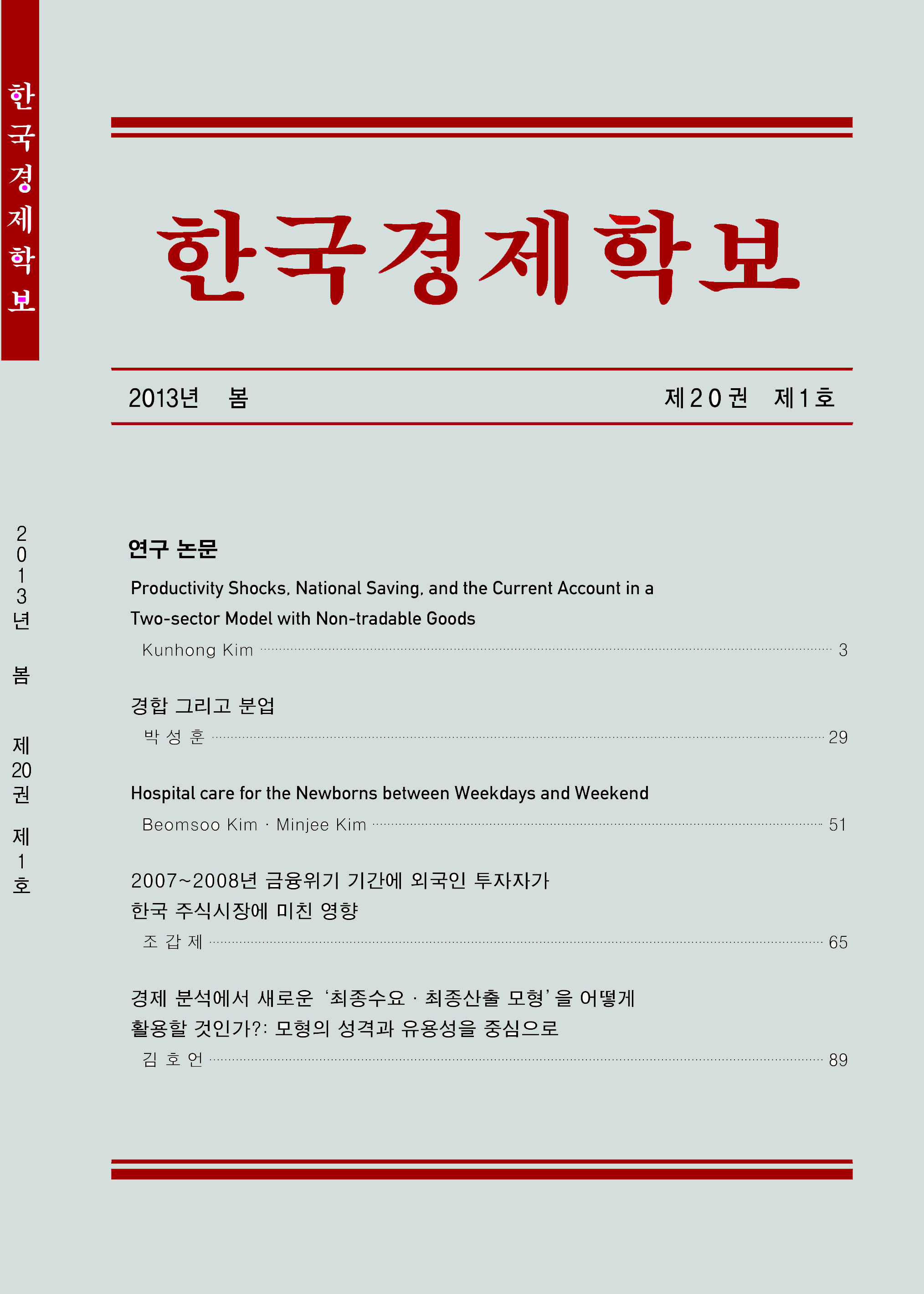
한국경제학보 제 32권, 제 2호 (2025년 가을)
임현준, 김찬우, 황나윤, 이정혁
Pages ages 51-76
-
Abstract ( Eng | Kor ) || PDF
- An Analysis of Housing Sales Price Spillover
Lim Hyun-Joon, Kim Chanwoo, Hwang Na Yun, Lee Junghyuk
This study measures the time-varying spillover effects between regions and between
housing sales markets, which significantly influence housing price fluctuations,
by estimating the DCC-GARCH model and TVP-VAR model and applying
the spillover index. The results show that, as commonly believed, housing sales and
rental prices in the Gangnam area and the Seoul metropolitan area exert strong influence
on surrounding regions. Over time, the spillover effects were relatively
smaller during periods of housing price decline, and the influence of the Gangnam
area has been gradually decreasing in recent years. Additionally, the spillover effects
of rental prices were found to be at a similar level to those of housing sales
prices. These findings were consistent across both the DCC-GARCH model and the
TVP-VAR model, demonstrating the robustness of the results to the choice of
model. The results suggest that when formulating housing and regional development
policies for specific areas, it is crucial to consider not only the direct effects on
the targeted area but also the spillover effects on neighboring regions.
- 본 연구는 주택가격 변동에 큰 영향을 미치는 지역간, 매매시장간 전이효과
(spillover)의 시간변화를 DCC-GARCH 모형 및 TVP-VAR 모형으로 각각 추정
한 후 전이효과 지수를 활용하여 측정하였다. 측정 결과, 강남 및 수도권의 주택매
매 및 전세가격이 주변에 강한 영향을 미치고 있는 것으로 나타났다. 시기별로는
주택가격 하락기에 전이효과가 상대적으로 작게 나타났으며, 강남지역의 영향은
최근 추세적으로 감소하고 있는 것으로 분석되었다. 아울러 전세가격의 전이효과
는 매매가격의 전이효과와 비슷한 수준으로 분석되었다. 또한 동 결과는
DCC-GARCH 모형과 TVP-VAR 모형에서 비슷한 수준으로 나타나 추정 결과가
모형의 특성에 대해 강건한 것으로 나타났다. 이러한 결과는 특정 지역의 주택
및 지역개발 정책 수립시 해당 지역에 미치는 직접 효과는 물론 주변 지역에
대한 전이효과 등 외부효과도 함께 고려하는 것이 중요함을 나타낸다.
리지아후이, 선주연
Pages 77-97
-
Abstract ( Eng | Kor ) || PDF
- An Analysis of China's Fertility Determinants: A Focus on Women's Labor Force Participation
Jia Hui Li, Joo Yeon Sun
This study investigates the determinants of China’s fertility rate using multiple linear regression, with a particular focus on female labor force participation. The analysis reveals that higher female labor force participation is positively associated with fertility. Fertility rates in the four major municipalities?Beijing, Shanghai, Chongqing, and Tianjin?remain lower than in other regions. The results also highlight significant regional disparities, emphasizing the importance of tailored population policies that consider local demographic and socioeconomic contexts. These findings suggest that declining fertility poses a critical social and economic challenge for China, requiring comprehensive policy interventions to support sustainable development. By providing empirical evidence on the interplay between female labor participation and fertility, this study contributes to a deeper understanding of population dynamics in the context of contemporary socioeconomic transformations.
- 본 연구는 중국의 출산율 결정 요인을 실증적으로 분석하였다. 다중선형회귀모형 분석결과, 여성의 노동력 참여율은 출산율과 유의한 정(+)의 관계를 보이는 것으로 나타났다. 이는 여성의 경제활동 참여가 증가할수록 출산율 역시 상승하는 경향이 있음을 의미하며, 여성의 고용 상태가 출산 결정에 중요한 영향을 미침을 시사한다. 특히 베이징, 상하이, 충칭, 톈진 등 경제 발전 속도가 빠른 4대 직할시는 다른 지역에 비해 낮은 출산율을 보였으며, 이는 지역 특성을 고려한 맞춤형 인구정책의 필요성을 제기한다. 본 연구는 중국의 출산율 감소를 구조적 문제로 규정하고 그 결정 요인을 분석함으로써 향후 출산정책 수립과 인구 연구에 유용한 학술적 근거를 제공한다.
Insoo Park, Daeyoung Jeong
Pages 99-128
-
Abstract ( Eng | Kor ) || PDF
- 가짜뉴스와 정치적 양극화
박인수, 정대영
본 논문은 네트워크 기반 소통 환경에서 가짜 뉴스가 선거 캠페인에 미치는 영향을 이론적으로 분석한다. 기본 모형은 두 정당의 전략적 후보 선정과 캠페인 계획을 포함하며, 유권자를 당파적 유권자와 독립적 유권자로 구분한다. 당파적 유권자는 정당 캠페인에서 직접 정보를 받지만, 독립적 유권자는 당파적 유권자와의 상호작용을 통해 정보를 획득하며, 이에 따라 미묘한 학습 과정이 형성된다. 우리의 분석 결과, 소통의 강도가 높아질수록 가짜 뉴스 생산이 증가하는 양의 상관관계가 관찰되며, 이는 잘못된 정보가 정치적 양극화를 악화시키는 역할을 강조한다. 구체적으로 독립적 유권자와 당파적 유권자 간의 통신이 강화될수록 선거에서 극단적 후보 선출 가능성이 높아지고, 정치 캠페인에서 오정보의 확산이 더욱 두드러진다.
- This paper presents a theoretical analysis of the impact of fake news on electoral campaigns within networked communication. The foundational model involves strategic candidate selection and campaign planning by two political parties, with voters categorized into partisan and independent groups. Partisan voters receive information directly from party campaigns, while independent voters rely on interactions with partisans, resulting in a nuanced learning process. Our findings demonstrate a positive association between intensified communication and an increased production of fake news, highlighting the role of misinformation in exacerbating political polarization. Specifically, heightened communication between independent and partisan voters correlates with a higher likelihood of selecting extreme candidates in elections, accompanied by an increased prevalence of misinformation in political campaigns.
The Korean Journal of Economics, Vol. 32, No. 2 (Autumn 2025)